
Planning season makes every priority feel equally urgent. Revenue growth, AI, customer experience, sales alignment, measurement and operational efficiency are all important. But not all deserve the same level of investment in every business.
Table of Contents
- What Should Your 2027 Marketing Plan Prioritize?
- The Most Valuable Input in Annual Planning
- Five Priorities Shaping 2027 Marketing Plans
- Is the Juice Worth the Squeeze? How to Evaluate Trends Through a Strategic Lens
- Build Flexibility into Your Annual Marketing Plan
- How to Build a Marketing Plan for 2027
According to Element's Marketing Pulse survey, 74% of marketers identify revenue growth as their top priority. Deciding which capabilities, investments and cross-functional decisions will have the greatest impact on growth for your organization is a key decision.
Fortunately, this guide provides a practical framework for answering that question. We'll break down the priorities shaping 2027 planning conversations, how they connect to business performance and how marketing leaders should focus their time, budget and resources.
What Should Your 2027 Marketing Plan Prioritize?
Strong planning conversations should always start with a business discussion rather than a list of marketing tactics you executed this year.
Often, organizations begin planning by evaluating campaigns, channels, platforms, and tactics. Effective teams go the opposite direction. They start by defining the business outcome they need marketing to support, then identify the priorities most likely to influence that outcome.
Growth, for example, can mean very different things:
- Increasing traffic to a specific location
- Generating demand for an underperforming service line
- Rebuilding momentum for a product category
- Increasing retention or customer lifetime value
- Helping sales convert more qualified opportunities
While all of these fit a growth objective on paper, the right marketing plan will look different for each situation.
Understanding existing success is another piece of the puzzle to consider. We've seen organizations commit significant energy to analyzing underperforming areas while overlooking valuable insights from parts of the business generating strong results. A thriving service line, product category, or location can reveal customer behaviors, messaging approaches, operational strengths, or sales practices that inform planning decisions.
The Most Valuable Input in Annual Planning
Many factors that influence marketing performance actually originate outside the marketing department.
- Sales: Common objections, lead quality, follow-up patterns and pipeline priorities
- Customer service: Recurring questions, friction points and retention risks
- Operations: Capacity constraints, process changes and service delivery updates
- Technology: New systems, website functionality, automation and data availability
- Leadership: Revenue objectives, expansion plans and organizational priorities
- The market: Customer demand, competitive pressure and industry developments
These conversations often reveal opportunities, risks and constraints that marketing would otherwise discover after the plan is already in motion.

Consider an organization implementing a new scheduling process, introducing customer service software, updating website forms, or adapting to changes in customer demand. Each of these developments may seem operational, yet each can affect lead generation, conversion rates, customer retention, campaign performance, and reporting outcomes.
Companies that share this information across teams are better positioned to build effective strategies because internal communication provides a more complete picture of the holistic customer experience. The quality of a marketing plan is directly tied to the quality of the information influencing it. Better business insight leads to stronger recommendations, more accurate assumptions, and greater alignment between marketing activity and organizational goals.
At Element, some of the strongest client partnerships are built on this exchange of information. Clients contribute deep knowledge of their industry, customers, and business operations. Our team contributes strategic perspective, integrated marketing expertise, and cross-industry experience developed through more than two decades of execution. Together, those perspectives create more informed planning decisions and stronger outcomes.

Five Priorities Shaping 2027 Marketing Plans
Several priorities continue to dominate planning conversations heading into 2027. While each priority's importance will vary by organization, they all contribute to a company's ability to attract, convert, and retain customers.
Revenue Growth
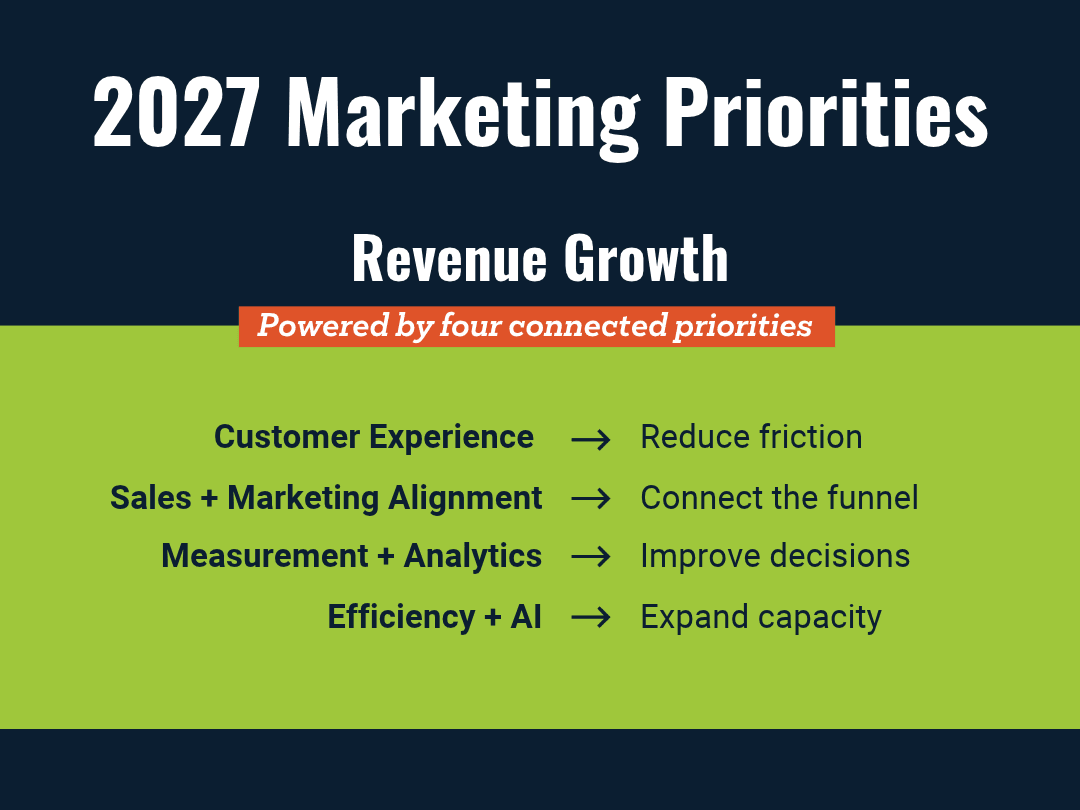
Revenue growth remains the core focus for most marketing teams, but marketing cannot deliver it alone. Customer experience shapes whether interest becomes revenue and whether customers return. Strong sales alignment keeps qualified opportunities moving instead of letting them stall between teams. Measurement shows where investments perform, while operational improvements and AI give teams more capacity to act on what they learn. The strongest organizations connect these priorities rather than treating them as separate initiatives.
Customer Experience
Marketing planning should consider the full customer experience. Generating awareness and demand is only part of the equation. Website usability and the ease of doing business can determine whether interest turns into a purchase. Identifying and reducing friction throughout the customer journey helps marketing investments work harder, improving conversion and giving customers more reasons to stay.
Marketing and Sales Alignment
Connecting marketing and sales should be a priority in marketing planning. When teams define success differently, gaps form between generating interest and closing business. Shared goals and agreed-upon metrics help both teams understand what's working and where opportunities are being lost. That connection makes it easier to focus marketing investments on what drives revenue.
Measurement and Analytics
An effective measurement strategy should be built into the marketing plan from the start. Connecting results to business goals helps teams see which investments are paying off and where to adjust. That insight supports smarter budget decisions and makes it easier to demonstrate marketing's contribution to business growth.
Operational Efficiency and AI
AI investments should support the goals already outlined in the marketing plan. With 60% of marketers planning to increase spending on AI tools next year, according to Element's Marketing Pulse survey, the opportunity is to put those tools to work where they can deliver business value. That could mean reducing repetitive tasks or using data to make better decisions, giving teams more capacity to move priority initiatives forward.
Is the Juice Worth the Squeeze? How to Evaluate Trends Through a Strategic Lens
Every planning cycle introduces a new collection of technologies, platforms, and industry trends competing for attention. Some offer real opportunities, while others generate more enthusiasm than measurable business impact. A disciplined evaluation process helps separate the two:
- Is it relevant to our audience?
- Will it benefit our bottom line or contribute to business outcomes?
- Is the opportunity timely, or will its relevance disappear before we can act?
- Do we have the right resources in place to take this on?
- How will we measure whether it worked?
A trend earns a place in the plan when the expected value justifies the resources required to execute it. If the business case is unclear, the juice probably is not worth the squeeze.
Build Flexibility into Your Annual Marketing Plan
Flexibility remains one of the most overlooked characteristics of effective annual planning. Many teams seek to document every initiative for the next twelve months, but business conditions rarely remain static for that long. Customer behavior changes, products launch on different timelines than expected, competitive dynamics shift, and new opportunities emerge throughout the year.
Stronger annual plans establish clear objectives, success metrics, budget parameters, and strategic initiatives while preserving room to adapt when circumstances change. This balance allows organizations to remain focused on long-term goals while responding thoughtfully to new information.
How to Build a Marketing Plan for 2027
As planning discussions move toward final decisions, marketing leaders should focus on a small set of foundational questions:
- Which business outcome requires the most attention?
- Which barriers are currently preventing progress toward that outcome?
- Which priorities will have the most significant impact on performance?
- How do marketing, sales, customer experience, and operations contribute to success?
- What measurement framework will guide optimization and decision-making throughout the year?
Answering these questions turns the marketing plan into a roadmap for business growth, with every investment tied to an outcome that matters.
Want more insights into what marketing leaders are prioritizing for 2027?
Download Element's latest Marketing Pulse Report to explore the trends, challenges, and investment priorities shaping next year's planning decisions.